Slow Practices for Sleep and Steady Days
Slow practices help with sleep and daily tension because they work through the body rather than through willpower. A short evening ritual, a few minutes of slow breathing, or a gentle standing practice like qi gong gives the nervous system something predictable to rest on. Nothing here is dramatic; the point is repetition, the same small gesture at roughly the same hour, most days.
The French-speaking magazine Le Temps d'un Souffle covers this same ground from a Francophone angle, with practical pages on insomnia, evening rituals, coherence breathing and slow movement, and its approach matches what works elsewhere: short instructions, third person, no promises.
Why does insomnia keep returning at the same hour?
Many people who wake at night wake at the same time, around three or four in the morning, and this regularity is a clue rather than a mystery. Sleep runs in cycles of roughly ninety minutes, and the lighter stages near the end of a cycle are where a stressed body surfaces fully. If cortisol and temperature begin their morning rise early, because the evening was late or tense, the light stage turns into a full awakening.
The habit that interrupts this pattern is not effort at three in the morning but structure earlier in the day. A fixed wake time, daylight within the first hour, and a genuine slowing down in the last sixty minutes before bed all move the whole night. Waking at the same hour is often the body reporting on the day before, not a defect of the night itself.
What evening ritual actually triggers sleep?
A ritual works when it is boring, and when it repeats. The content matters less than the sequence and the hour. A workable version takes thirty to forty-five minutes and might look like this.
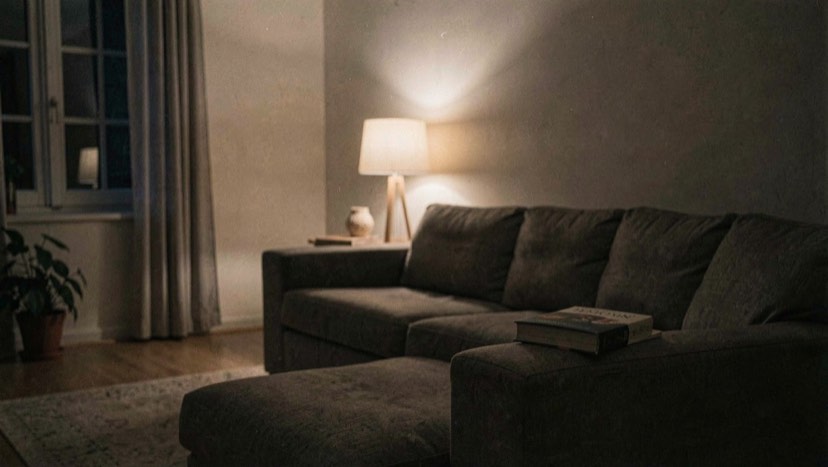
Lights lowered to warm, dim levels. Screens set aside or at least silenced. A warm shower or bath, which raises then drops skin temperature, a drop the body reads as a signal for sleep. Then something slow and manual in low light: stretching on the floor, folding clothes, writing three lines in a notebook to park tomorrow's worries. The bed is entered at roughly the same time each night, and if sleep does not arrive within about twenty minutes, the rule is to get up, sit in dim light, and return when sleepy.
The ritual is a runway. Its length gives the body time to descend; its sameness tells the body where it is heading.
Can five minutes of breathing really lower tension?
Slow breathing at around six breaths per minute, often called cardiac coherence in French-language writing, is one of the most studied of the simple practices. Five minutes of it, feet flat, back straight, exhaling slightly longer than the inhale, tends to slow the pulse and soften the feeling of pressure. The mechanism is the vagus nerve responding to the rhythm of the breath.
The version that survives daily life is the discreet one. Before a meeting, after a difficult email, on a train: three or four slow breaths, attention on the exhale, nobody around notices. Done at a fixed time, perhaps mid-morning and mid-afternoon, it becomes a small valve used before the pressure builds.
The World Health Organization describes stress management for adults as built on exactly these kinds of regular, low-cost practices rather than occasional heroic efforts.
What is qi gong, and who is it for?
Qi gong is a Chinese practice of slow, repeated movements coordinated with the breath, usually done standing. It comes from the same family of practices as tai chi, with roots going back centuries in monastic and popular traditions, though its modern forms were largely standardized in the twentieth century. A session might involve nothing more than shifting weight from foot to foot while circling the arms, or standing still for a few minutes with attention on the lower abdomen.
It suits people who find seated meditation restless, because the moving body gives the attention somewhere to go. It suits stiff mornings, small apartments, and beginners, because the movements are short, gentle and learned one at a time. Ten minutes after waking, before coffee, is enough to begin.
Meditation and yoga nidra: how do they differ?
Meditation, in its simplest form, is sitting still and returning attention to one thing, usually the breath, each time it wanders. The returning is the practice; the wandering is not failure. Hand positions, or mudras, appear in several traditions as a way of giving the hands a fixed, quiet place, which some people find steadies the whole posture.
Yoga nidra is different: it is practiced lying down, and it consists of following a guided sequence of attention through the body rather than holding focus on one point. Because it requires nothing but a floor, a blanket and a voice, it is often the easiest door into relaxation for people who cannot face sitting. Twenty minutes in the early afternoon or before bed is a common frame.
A calm progression for a beginner might be: slow breathing for a week, then ten minutes of seated attention, then yoga nidra on days when the mind is too loud to sit.
How do these habits fit into one day?
The steady version is small. In the morning, ten minutes of qi gong or a short walk before the first screen. At midday, a genuine pause of five minutes, breathing slowly, ideally away from the desk. In the evening, the runway: dim light, warm water, slow movements, a fixed bedtime.
None of these gestures fixes anything on its own or overnight. Their value is cumulative, the way a path forms across grass. One week shows little; three months of the same small sequence at the same hours changes how the evenings and the mornings feel, and how the middle of the night reports on the day that came before it.
Read next
The evening routine does not have to end with the lamp switched off. Some people keep a small notebook and a deck of cards on the side table, and spend ten quiet minutes on symbols rather than screens. For anyone starting with astrology and tarot, the first steps stay modest: learn the twelve signs and four elements, then the planets and houses, then a three card spread. Numerology adds one number, the life path, calculated from a birth date. None of it requires belief, only repetition, the same way a walk is repeated.