The Afternoon Light Habit and a Better Night's Sleep
Most people who work indoors go from a lit kitchen to a lit office to a lit living room and, if the season is unhelpful, never once stand in daylight. The afternoon light habit is the smallest possible correction to that: ten minutes outside, or at an open window, somewhere in the middle of the day.

The indoor afternoon
An ordinary indoor afternoon is remarkably uniform. Electric light holds a room at a constant level from nine in the morning until the lamps go on, so nothing in the visual environment changes between lunch and the evening. If light is one of the cues a body uses to work out where it is in the day, an indoor afternoon supplies almost no information at all.
Outside, the picture is entirely different, and the difference is larger than people expect. Standing in the open on an overcast afternoon is a different order of brightness from sitting under office lighting, even office lighting that feels perfectly bright to read by. The eye adjusts so smoothly that the gap is invisible from the inside, which is why the habit has to be deliberate: nothing about the indoor afternoon feels dim.
Light indoors and out
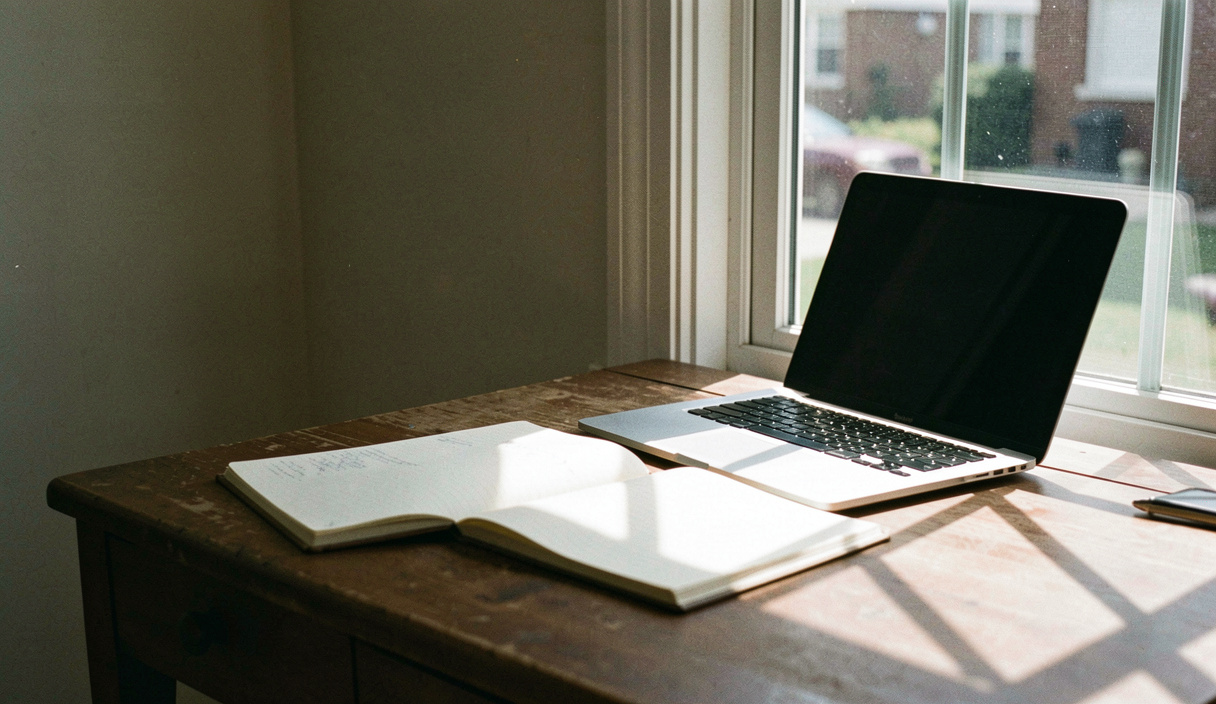
The practical hierarchy, from most to least, runs roughly like this: outdoors in open shade, outdoors under cloud, a seat directly beside a large window, a room with a window somewhere in it, a room without one. The interesting part is how quickly the value falls off with distance from the glass. Two metres back from a window is a different place, in light terms, from being at it.
That single fact is behind one of the cheapest changes to a home or an office, which is moving the desk rather than adding a lamp. We set out how that is done, and what it costs in room layout, in the entry on letting more daylight into an ordinary day at home.
THE NEIGHBOURING HABIT
Afternoon light and afternoon movement are the same ten minutes if you let them be. Walking after a meal gets you outdoors without any separate decision being made, which is why the two habits are usually kept together rather than separately. The mechanics of that walk, and the three reasons it tends to die in its second week, are in the entry on a loop you can turn round in at any moment.
Where the ten minutes fit
Three slots turn up again and again, and all three work because something already happens in them.
A fourth slot is less obvious: the pause between clients or tasks, when hands are already idle. Ten minutes outdoors at that point does not compete with work, because nothing was scheduled there. The habit holds in winter and on grey days, since daylight intensity, not sunshine, drives the effect. For readers who colour hair at home, the same logic applies to supplies: buying tubes in bulk during a destockage coloration professionnelle sale removes the repeated errand and the repeated decision. Stock is limited and rarely restocked, so the pause is also the moment to check what runs out next.
The first is immediately after lunch, which has the advantage of an obvious trigger and the disadvantage of being the slot most often eaten by a meeting. The second is the coffee that would otherwise be made and drunk at a desk: the same drink, carried outside, costs nothing extra. The third is the first half of the walk home or to the station, which is already outdoors and simply needs to be lengthened rather than invented.
What does not work, in our experience, is a slot with no trigger. Ten minutes of daylight at some point this afternoon is not a habit, it is a hope. Attaching it to a thing that already happens is the entire technique, and it is the same technique described in the entry on making a new habit small enough to start.
Winter and grey days
Two objections come up every time. The first is that it is cloudy. The answer is that outdoors under thick cloud is still a different order of brightness from indoors, and that the habit is not about sunshine. The second objection is that in winter the working day begins and ends in the dark, which is true in a great deal of Europe and is not solved by good intentions.
In that case the middle of the day is the only slot there is, which makes the lunchtime version less optional rather than more. A window seat for the meal itself, chosen deliberately, is the fallback when going outside is genuinely impossible.
Nothing about an indoor afternoon feels dim. That is precisely why the habit has to be a decision rather than a preference.
What we noticed
Keeping the habit for a fortnight, the effect we could report honestly was on the afternoon rather than on the night. The middle of the day felt less like one continuous block. Whether that showed up at bedtime is not something we can claim to have measured, and we are not going to pretend a fortnight of notes says anything about sleep quality as such.
What we can say is which version survived. The coffee carried outside survived every day. The dedicated ten minute walk survived on the days without a one o'clock meeting, which was about half of them. The window seat at lunch survived only when the seat was actually free, which is a small logistical fact that decides more habits than motivation does.
If the evening end of the same question is what brought you here, the sequence that gives an evening its shape is set out in the evening sequence entry, and the case for a steady waking hour is made in the piece on a steady waking hour.
Read next
The cheapest way to get the light is to be walking anyway, which is the whole of our entry on the walk that needs no equipment.
At home the same question becomes a furniture question. Our entry on daylight and the layout of a flat covers curtains, desk position and the corner that never gets any sun.
Moving a desk towards a window changes the screen glare and the seating angle, so it is worth reading alongside the entry on screen height and chair position.
The evening counterpart to this habit is what changes when screens are put away before bed, which deals with light at the other end of the day.