Screens Before Bed: What a Small Change Does
The advice to put screens away before bed is so familiar that it has stopped carrying any information. What is less often described is what actually happens when someone does it: what changes in the room, what changes in the hand, and what turns up to fill an hour that has just been emptied.
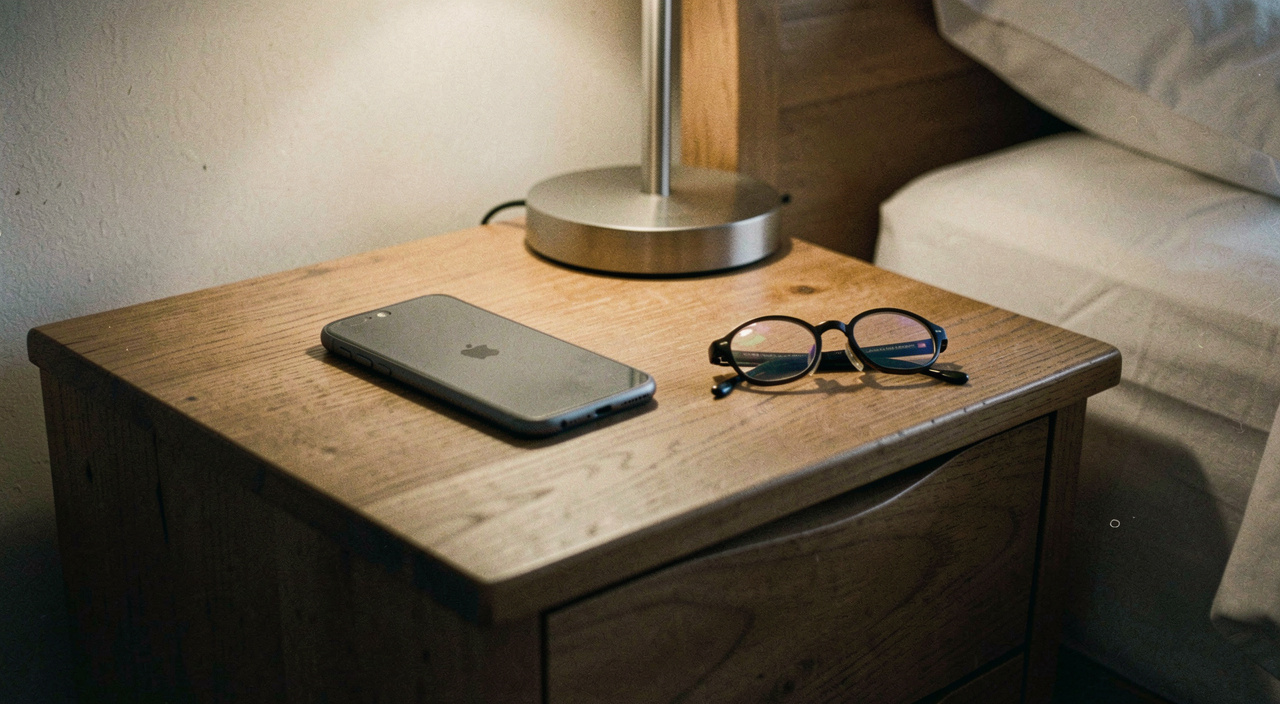
The hour that becomes empty
The first thing anyone notices is that the hour is long. A phone compresses time: an hour spent scrolling registers as fifteen minutes, and the same hour without one registers as an hour. People often describe this as boredom and treat it as evidence that the experiment has failed.
It is worth naming it differently. The hour was always that length. What the screen was doing was hiding it. An evening that suddenly feels long is an evening that has been handed back, and the first two or three nights of that feel uncomfortable in the way that any returned time does.
This is also why the change works better as part of a sequence than as an isolated act of will. If the light has already come down and the room has already been reset, the empty hour has a shape to sit in. That sequence is the subject of the entry on the order those steps go in, and the screen step is the third of its four moves for exactly this reason.
Three things that shift
Beyond the length of the hour, three specific things change, and they are worth separating because people tend to attribute all of the effect to the first one.
Brightness. A screen held at arm's length in an otherwise dim flat is by a distance the brightest object in the room, and it is aimed directly at the face. Setting it down does not just remove that light, it also lets the room's own light level become the thing your eyes are adjusted to, which makes a single lamp feel adequate rather than gloomy.
Notifications. The second shift is about interruption rather than light. Every arriving message is a small piece of unfinished business, and unfinished business at eleven at night has a way of staying open. Silencing them is a separate action from putting the device down, and it is the one people forget, because a phone on a shelf that still lights up and buzzes is a phone that is still in the room.
The pull. The third is the hardest to describe and the most consistent: the reflex of reaching for it. A scroll has no end, so there is never a natural moment to stop, and the decision to stop has to be made against a feed designed not to offer one. Remove the object and the decision disappears with it.
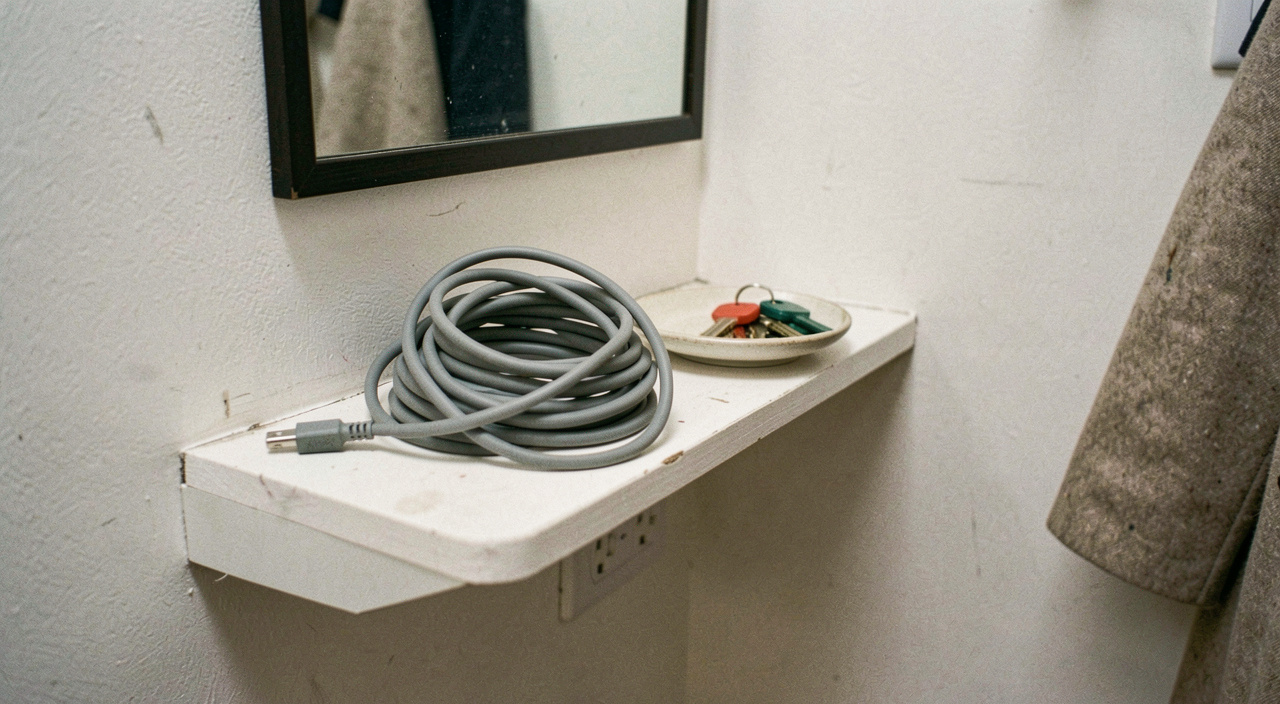
The distance that matters
A great deal of writing on this subject insists that the phone must leave the bedroom entirely. That version is clean, it is easy to write, and in our own experience it lasts about two nights before an alarm clock argument ends it.
The version that lasts is duller. The phone stays in the flat, sometimes even in the same room, but it goes somewhere that requires standing up: a hallway shelf, a kitchen worktop, the far side of a bedroom. The distance that matters is not measured in rooms. It is measured in whether the arm can reach it from where the body already is.
The most effective single change we found was moving the charger rather than the phone. A charger on a hallway shelf makes the phone's overnight location a settled fact rather than a nightly negotiation, which is the same principle as buying the lamp instead of resolving to use less light. Making the environment carry the habit rather than the person is the argument of our entry on light habit tracking and of most of the Habits section.
The distance that matters is not measured in rooms. It is measured in whether you have to stand up.
What replaces the scroll
An emptied hour has to contain something or it fills itself back up. Three replacements came up repeatedly and they are unequal.
| Replacement | Why it works | Where it fails |
|---|---|---|
| A paper book, left open on the chair | Visible, needs no decision, ends by itself | Only if the chair has a decent lamp |
| Three lines in a notebook | Closes the open loops from the day | Skipped on the evenings with most to write |
| Tidying one surface | Physical, short, changes the room | Becomes a longer job if you let it |
The notebook version is worth a closer look than we can give it here, and it turns out to be a habit in its own right rather than a sleep aid. We describe it in the entry on five minutes of journaling most days.
The version that survived

Across a fortnight, the honest report is that the full hour never happened. What happened was closer to forty minutes on good evenings and ten on bad ones. The parts that held were the two that required no willpower at the time: the charger in the hall, and the notifications silenced on a schedule rather than by hand.
The part that did not hold was the intention to read for the whole hour, which lasted about four evenings out of fourteen and always failed on the same sort of evening, the late ones. That is a familiar shape by now, and it is the reason this magazine keeps returning to the smallest workable version of a thing rather than the best one.
One last observation. The change was easier to keep on days that had contained daylight and some walking, which is not a claim about mechanism, just a pattern in our own notes. If that connection interests you, it is taken up directly in the entry on light in the middle of the day.
Read next
This entry describes one step of a longer sequence. The other three are in the entry on the four moves that end a day, and the light, room and object moves are set out there in order.
If the reason the phone keeps coming back out is work rather than habit, the relevant piece is on drawing a line at a certain hour.
An emptied evening needs somewhere to be spent, and the entry on a chair, a lamp and a surface for a cup is about assembling that place out of a chair and a lamp.
The charger trick is a general principle: change the environment once instead of deciding every night. That is the whole argument of the piece on defining a habit by its two minute version.