A Calmer Way to Read a Food Label
A supermarket is an unusually bad place to do arithmetic. The lighting is flat, the trolley is in the way, someone is waiting behind you, and the packet is designed by people who have thought about it far longer than you are about to. A label habit that requires concentration is a label habit that will not last a month.

The aisle problem
Most advice about labels assumes a kitchen table, good light and time. In the aisle none of those apply. So the useful version has to be short enough to do while walking, and robust enough that doing it badly still leaves you better informed than not doing it.
There is a second problem, which is that reading labels closely can quietly turn a weekly shop into an anxious activity. Once every packet becomes a small examination, the shop takes forty minutes longer and stops being pleasant. The aim here is the opposite: a glance that ends quickly and lets you move on.
Ingredients before numbers
The single most useful fact about a label is one of the dullest: the ingredient list is written in order of quantity, most first. That one convention turns a paragraph of small print into something you can read at a glance, because the first three words carry most of the information.
If a product is called a fruit bar and the first ingredient is not fruit, that is a complete answer and you do not need the table underneath. If a loaf lists flour, water, salt and yeast, that is also a complete answer. Whether either matters to you is your business, but the reading takes two seconds rather than two minutes.
The other useful convention is length. A very long list is not automatically a bad thing, but it does tell you something about how far the food is from a kitchen, and that is often the thing a person was actually trying to find out when they picked the packet up.
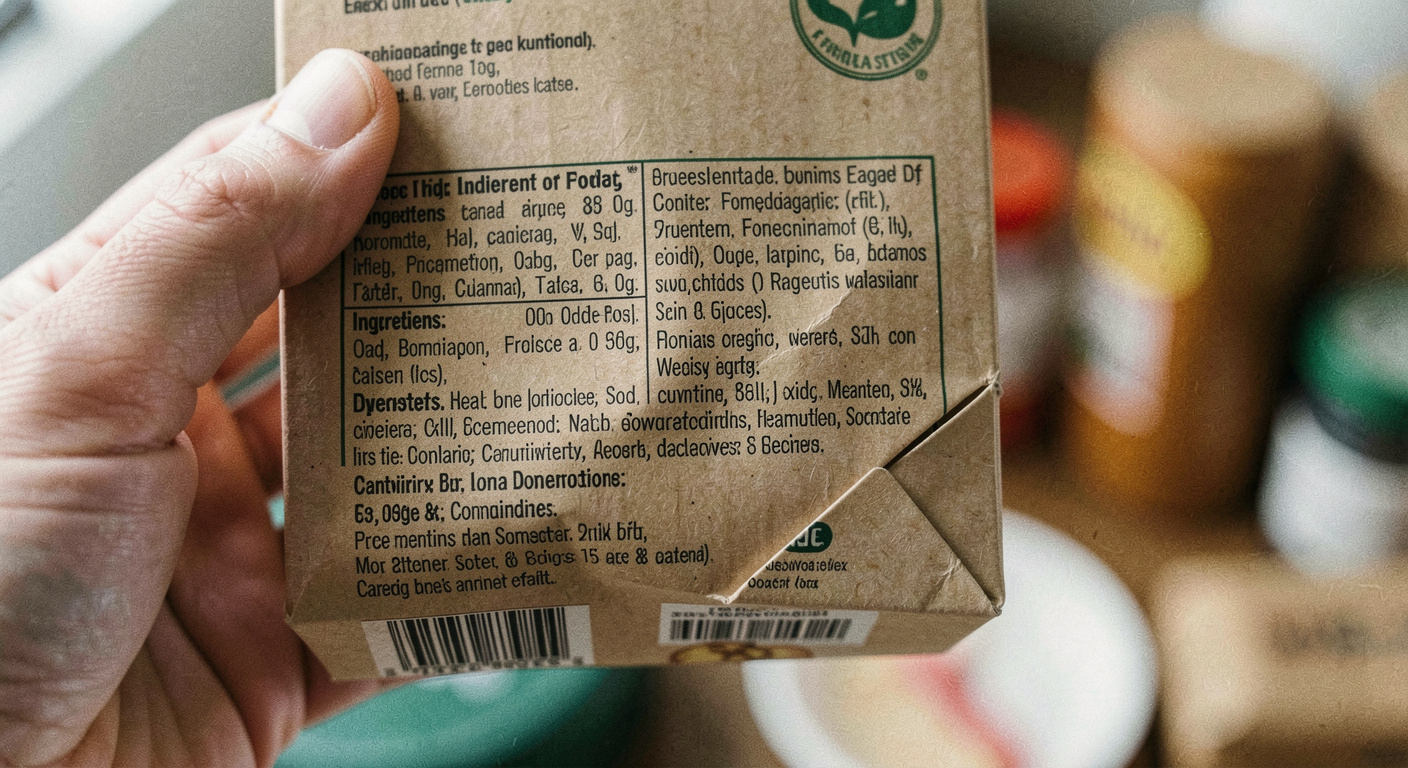
The ten second glance
The routine that survived our own shopping was three moves and no arithmetic.
| Move | What you are looking at | Time |
|---|---|---|
| Turn the packet over | The ingredient list, not the front of the box | Two seconds |
| Read the first three ingredients | Whether the product is mostly what it says it is | Four seconds |
| Notice the length of the list | How far this is from something cooked at home | Two seconds |
That is it. No per hundred grams comparison, no traffic light matching, no mental division. If after those ten seconds you still want to know more, put it in the trolley and read it at home, where the light is better and nobody is waiting.
The front of a packet is advertising. The back of it is the only part written to a standard.
Where the numbers do help
There is one case where the numbers earn their place, and it is comparison rather than assessment. Two similar products, side by side on the same shelf, in the same units. That comparison is quick, it is meaningful, and it does not require any target to be held in your head.
What does not work is judging a single product against a remembered standard. Nobody carries reliable reference figures around, the units differ between countries and packet sizes, and the result is usually a decision made on a half remembered rule. Comparison is easy. Judgement in isolation is not.
The deeper fix is upstream of the label anyway. A shopping list built around a small number of repeated meals means most of the trolley never gets read, because it is oats, eggs, bread and vegetables that carry no interesting label at all. That is the practical benefit of the template described in the entry on a simple breakfast plate: it shortens the list, and a shorter list is a shorter shop.
What we noticed
Doing the ten second version deliberately for two weeks, the main effect was on time rather than on the trolley. The shop got shorter. Two or three items changed, mostly in the bread and cereal aisles, and the rest of the basket was identical to what it had been before, because most of it was food without a label worth reading.
The second observation is about mood. Reading the back of a packet turned out to be far less unpleasant than reading the front of it. The front is where the claims are, and the claims are the part that makes a supermarket feel like an argument. The ingredient panel is comparatively restful, which is not a word anyone expects to use about small print.
If the reason you are reading labels at all is that meals feel rushed and unconsidered, the more useful habit is probably not in the aisle. It is at the table, and it is described in our entry on the four minute meal. The habit of drinking something with the meal belongs to the same territory and is covered in the hydration entry.
Read next
A shorter list makes a shorter shop, and the shortest list comes from a repeatable plate: see the piece on four slots and one shelf.
What happens after the shopping matters more than the shopping, which is the case made in the entry on what changes when a meal is unhurried.
Ten seconds is a deliberately small unit, chosen for the same reason as in the entry on shrinking a habit to two minutes: small habits start, large ones get postponed.
If a supermarket reliably leaves you wound up, the short reset described in the entry on a counted breath before a difficult moment works in a car park as well as anywhere else.
There is a quiet kind of preparation that sits well with a steady day, and price research belongs to it. In France, professional hair colour varies widely from one salon to another, and the brands and technical references behind each service explain much of that spread. A recent entry in the habits and routines section takes a calm look at how these figures are gathered, which product lines are covered, and why technical guides give salon clients a clearer footing before they book. It reads a bit like comparing prices before buying at the market: no rush, just the facts laid out, so the decision arrives on its own.