A Simple Breakfast Plate Worth Repeating
A breakfast that has to be invented at seven in the morning is a breakfast that gets skipped. The useful question is not what should be on the plate but how few decisions stand between waking up and eating, and how many of those decisions can be settled once instead of daily.
The decision is the problem
Ask people why they skip breakfast and the answer is almost never hunger. It is time, and underneath time it is choice. Choosing takes longer than eating. A person standing in front of an open fridge at ten past seven is not short of food, they are short of a default.
Everything below is aimed at the default rather than at the nutrition. That is deliberate. A very good breakfast eaten twice a month is worth less than a fairly ordinary one eaten most days, and the ordinary one is the only kind that repeats. Repetition is the whole subject of this magazine.
Four slots on a plate
The template we ended up using has four slots. It is not a rule and it is not a diet. It is a way of looking at a plate quickly and seeing what is missing.
| Slot | Usually filled by | Kept where |
|---|---|---|
| Something with protein in it | Eggs, yoghurt, cheese, tinned fish, leftover pulses | Fridge door, front row |
| Something starchy | Bread, oats, cold potatoes, rice from the night before | Cupboard, one shelf, visible |
| Something from a plant | Tomatoes, an apple, frozen berries, a handful of spinach | Bowl on the counter, or freezer |
| Something with fat in it | Olive oil, butter, nuts, seeds, avocado | Next to the hob |
The point of the four slots is speed of assembly. Nobody is weighing anything. You look at the plate, notice that three of the four are covered, add the fourth if it is within reach, and sit down. On the mornings when only two are covered, that is a breakfast too.
A very good breakfast eaten twice a month is worth less than an ordinary one eaten most days.
The cupboard does the work
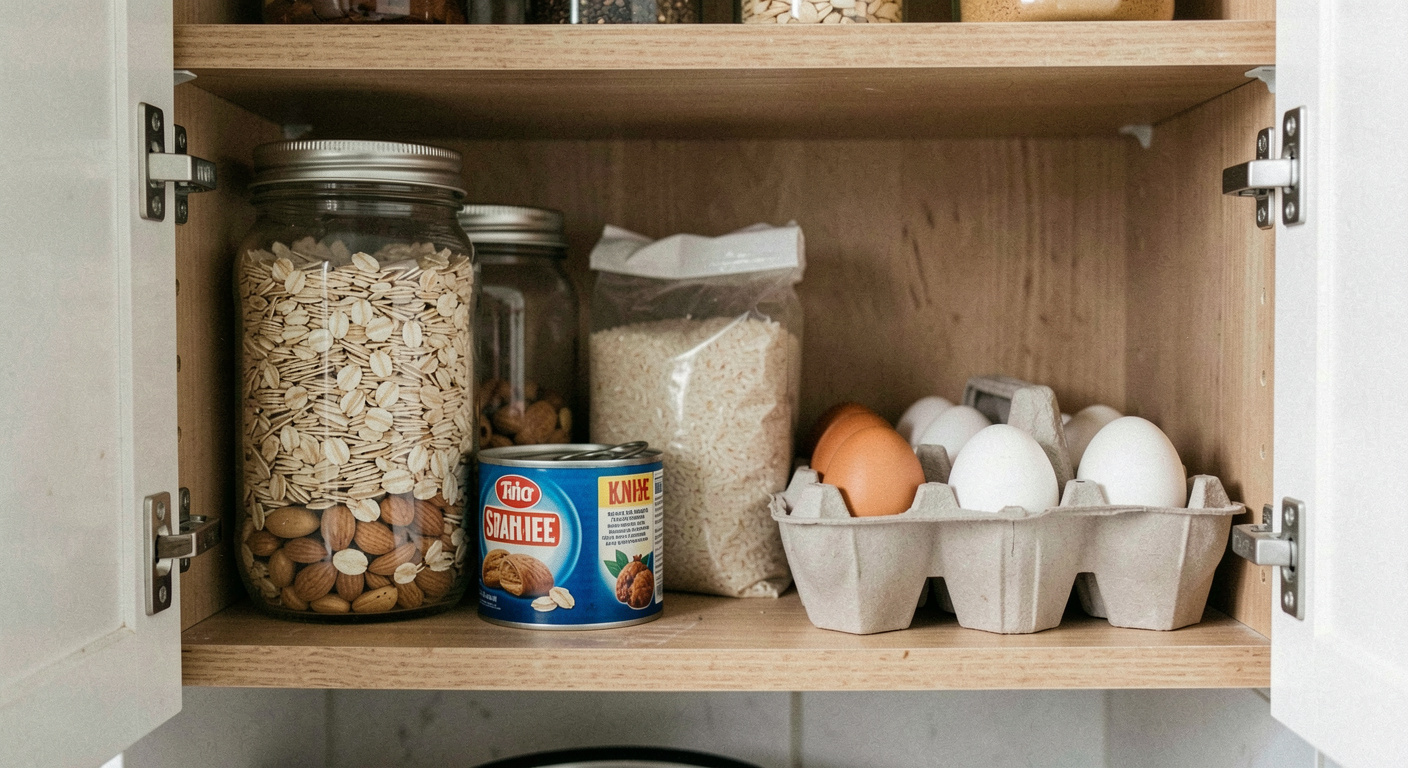
The most effective change we made had nothing to do with cooking. It was moving breakfast things to one shelf at eye level and moving everything else off it. A cupboard organised by category rather than by meal makes every morning a small search, and small searches at seven in the morning end with toast and nothing else.
This is the same principle as moving a phone charger to the hallway rather than resolving to use the phone less: change the environment once and the decision stops having to be made. We describe that specific case in the entry on setting screens aside before bed, and the general version in the two minute rule.
The shopping side follows from it. A list built around the four slots is short and dull: eggs, oats, yoghurt, bread, one fruit, one vegetable that survives a week, nuts. If reading the packets is where your supermarket trips get long, that is a habit in its own right and we take it apart in the entry on reading a label without turning it into arithmetic.
Three plates that repeat

Three assemblies covered most of our own mornings. They are unremarkable on purpose.
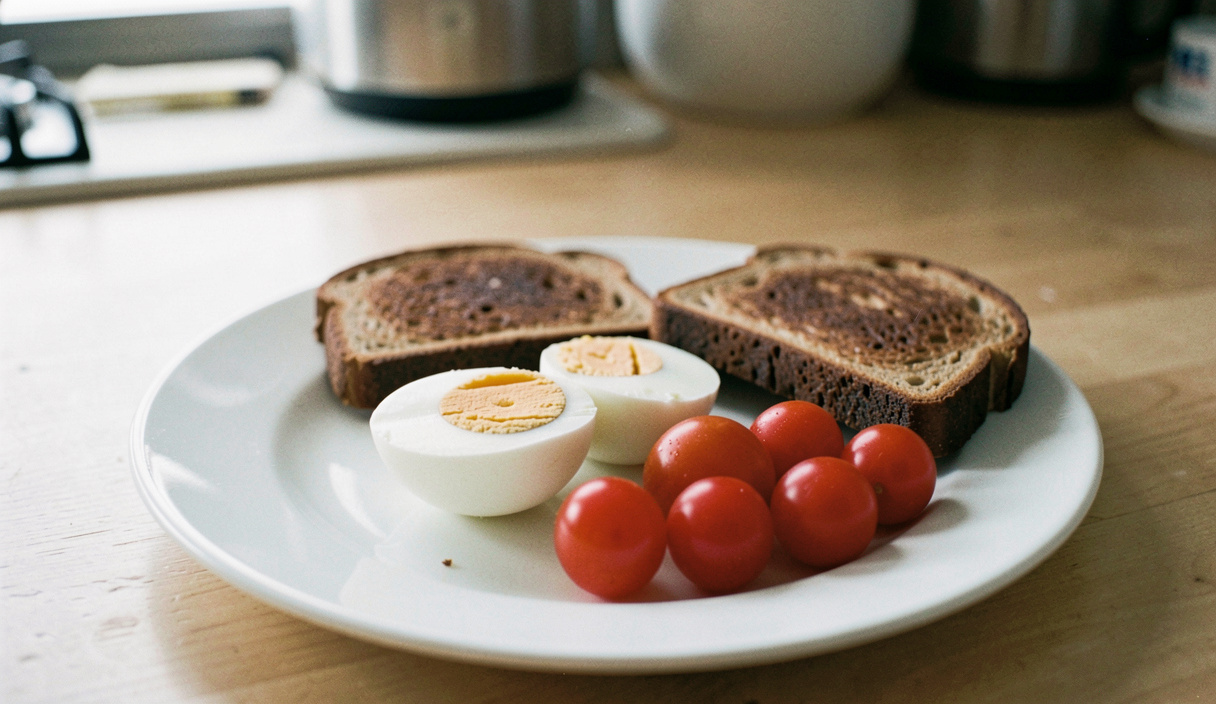
The cooked one. Two eggs, a slice of bread, tomatoes, olive oil. Ten minutes with a pan, and the only version that requires standing at the hob. It happens on the days when the morning has slack in it.
The cold one. Yoghurt, oats stirred in raw, frozen berries, a spoon of nuts. Two minutes, no heat, no washing up beyond a jar. This was the one that survived the late mornings, and it is worth having a cold version specifically for that reason.
The leftover one. Whatever was cooked the night before, eaten on a plate at breakfast time without ceremony. Rice, beans, roast vegetables, a piece of chicken. The objection to this is cultural rather than practical, and it disappears after about three days.
The night before
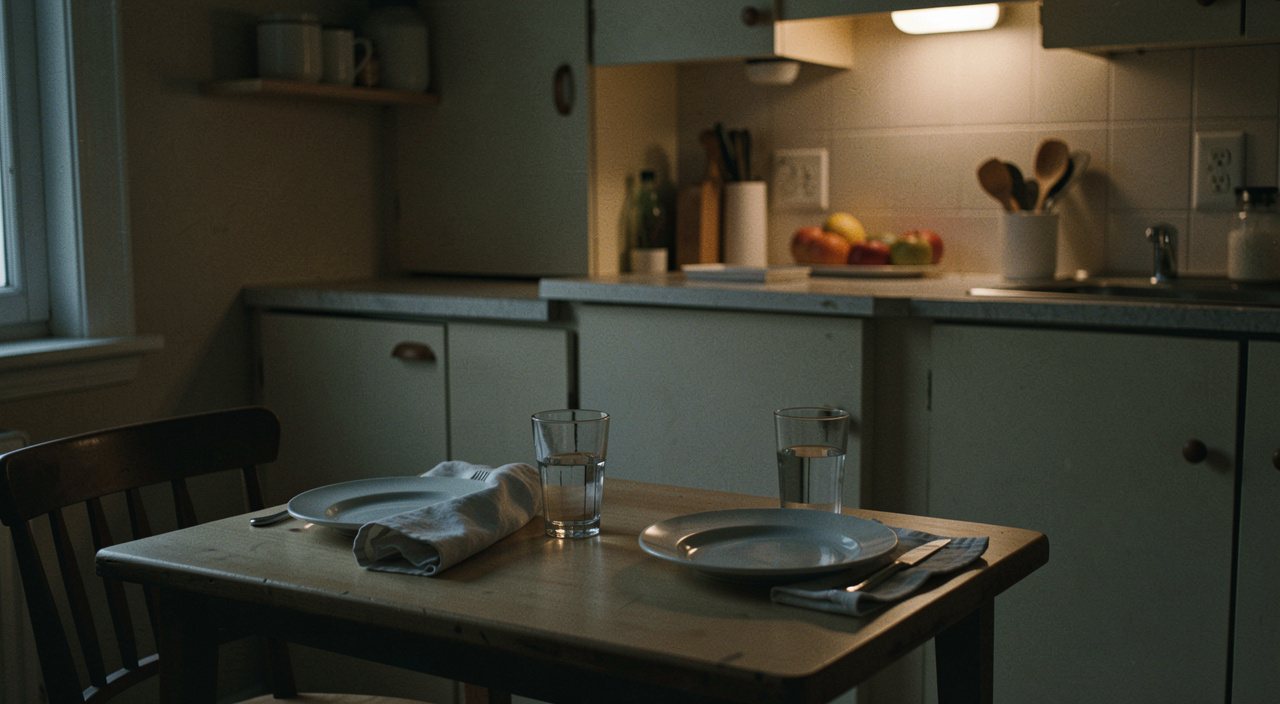
Anything that can be moved to the previous evening should be. Not preparation in the elaborate sense, which lasts a fortnight and then stops, but the small physical things: the jar out of the cupboard, the plate on the table, the oats measured into a bowl, the kettle filled.
Two minutes in the evening buys about eight minutes in the morning, and more usefully it removes the moment of standing in front of an open cupboard. It also fits naturally into an evening routine that is already resetting the kitchen, which is the fourth step of the sequence described in the wind down entry.
THE NEIGHBOURING HABIT
Breakfast is the meal most likely to be eaten standing up, in a hurry, in front of a screen. Slowing it down by even a few minutes changes what people report about the meal more reliably than changing what is on the plate does. That case is made separately in the entry on eating a little slower, which is the companion piece to this one.
What we noticed
Over a fortnight the cold assembly happened most often, the cooked one about twice a week and the leftover one whenever there were leftovers, which was less often than we predicted. The four slot template did what it was supposed to do, which was to stop the plate from being bread and nothing else, without anybody counting anything.
The change with the largest effect was the shelf. Once breakfast items lived in one place at eye level, the morning search disappeared, and with it the main reason breakfast was skipped. That is a shelf, not a resolution, and it is the sort of one time fix that this magazine keeps ending up recommending.
The change with the smallest effect was ambition. Every attempt at a more interesting breakfast lasted between two and four days. We would rather report that plainly than pretend otherwise, and it is the reason the three plates above are as dull as they are. For the drink that goes alongside, and the habit that is even easier to forget, see the entry on hydration habits built around a real schedule.
Read next
The companion entry on eating a little slower deals with the meal itself rather than its contents, and it applies to breakfast more than to any other meal.
If the shopping trip is where this falls apart, the calmer approach to reading a label keeps the supermarket part short.
The shelf trick is a specific case of a general idea, set out in the two minute rule for starting a habit.
The two minutes spent laying the table belong to the evening, and they fit into the sequence described in the wind down routine.